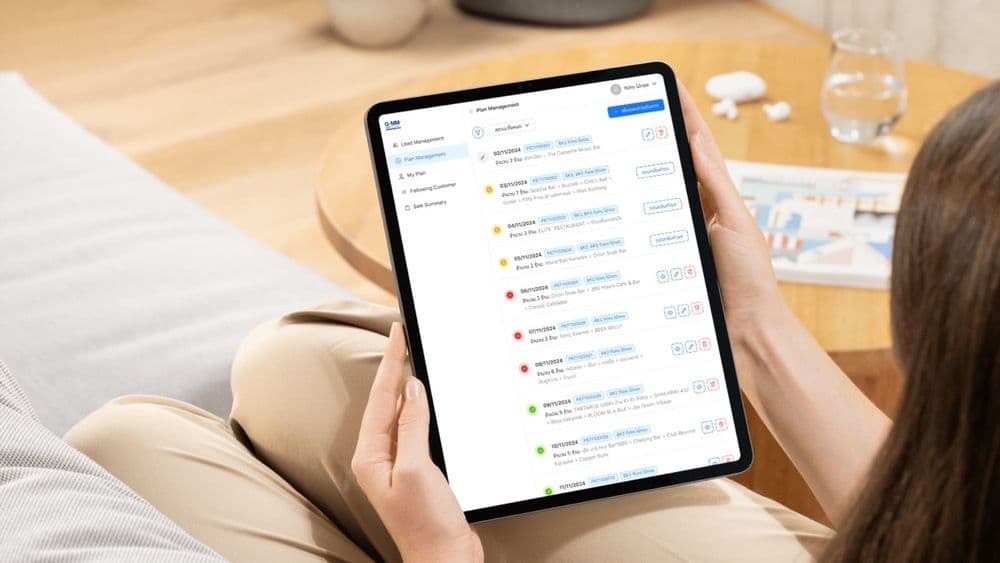
GMM Music Publishing International
From first visit to renewal: designing GMM MPI’s licensing CRM
- UX/UI Design & User Research
- Business Process Management
- Solution Architecture
We map how work is done today, workarounds included, measure where the time goes, and redesign the process with the people who run it. The result is a process definition precise enough to build software from.
Business process management means mapping how work is done, redesigning it where the change pays for itself, and deciding what to automate before any of it is written into software.
For MEMO Clothing we mapped the wholesale order process, which ran through a LINE group, and redesigned it before building the web app. We also mapped how maintenance teams work for a manufacturer's maintenance system, and designed the sales workflow for GMM Music Publishing's CRM.
Staff work around the written process
The workarounds are not in the manual, so the next system will be specified without them.
Work waits on one approver
Approval authority never moved as the organisation grew, so requests queue behind one person.
The same data is typed in twice
Orders or records are re-entered into a second system because the two do not share data.
Nobody knows how long the process takes
There is no measured cycle time, so talk of improving it rests on opinion.
Process discovery and mapping
How the work is done, workarounds included, captured by watching it as well as through interviews.
Cycle time and cost analysis
Where time and money go at each step and handoff, measured from records and observation.
Redesign with your staff
A new process agreed with the staff who will run it, so they keep following it after launch.
Automation assessment
Which steps to automate, which to simplify first and which should stay manual.
Requirements for the next system
A process definition, with approval rules and exceptions, precise enough for a development team to build from.
Every engagement runs through the same six-stage fitting process, from the first consultation to long-term care. The stages stay in the same order; how deep each one goes depends on the project.
See the full fitting processAutomating a process as it stands turns every workaround and extra approval into code. Reviewing it first is cheaper, because a step removed during redesign does not have to be built or maintained.
We watch the work with the people who do it and measure where requests wait. Then we ask what each step is for. Some approvals were added after an old incident or because an earlier system could not do something, and those reasons may no longer hold.
We write findings in specific terms. A finding such as "this approval adds four days and has not rejected a request in two years" gives a process owner a clear decision to make.
We also mark what should stay manual. Low-volume work that depends on judgement usually costs more to automate than it saves. Automation pays on high-volume work that follows fixed rules.







Engagements span build, integration and long-term support. Named with permission; clients under NDA are not listed.
It depends on how many processes and teams are in scope and whether the work leads into a system build. One process is a smaller job than a programme across several departments. We give a written estimate after a short scoping call, or price against the TOR for public-sector work.
Not always. If the process is stable, well understood and works, go straight to build. Process work is worth doing when the documented process and the real one have drifted apart, when approval rules are complicated, or when nobody can say how long the process takes.
Only where it fits. Platforms bring licence costs and need specific skills to run, and RPA can keep a poor process in place by making it cheap to run as it is. Often the better option is to simplify the process and build the small part that needs software.
Then we say so. Some processes look odd from outside and turn out to be that way for good reasons. Finding that out costs less than a change programme, and the map and measurements stay useful for the next system decision.
Yes. Process work fits well ahead of a fixed-scope build, because it makes the TOR specific enough to deliver and to produce bids that can be compared. MERCIL is registered with Thailand's Public Debt Management Office (PDMO) as an ICT consultant, No. 6745, Rating 1.
GMM Music Publishing International
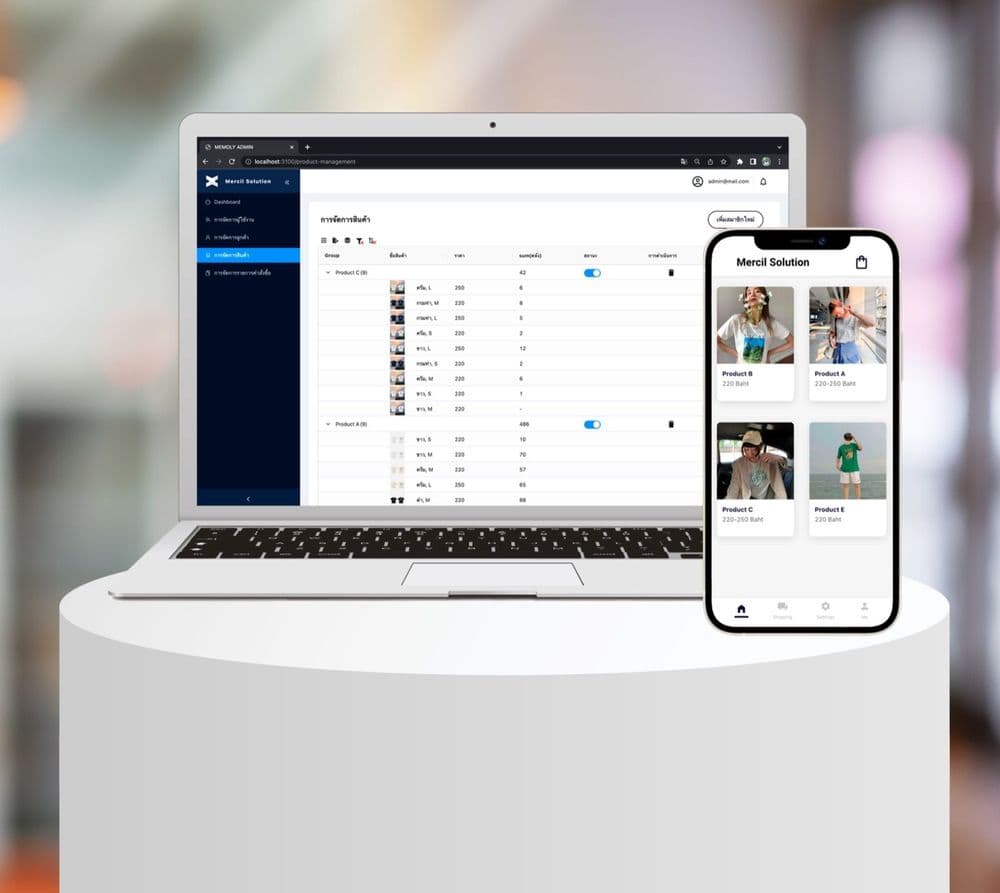
MEMO Clothing
97%customer satisfaction, up from 53%
Next step
Tell us about the problem you are trying to solve. A senior person reads every inquiry and replies with our view of fit, scope and cost, including when another option would suit you better.
We use essential cookies to make this site work and, with your consent, Google Analytics and Hotjar session recordings to understand how it is used. Forms are hidden in recordings. Cookie policy